Projects / Case study
Verlinghem Loisirs
Redesign of a village association website: thirteen activities, three venues, and content volunteers can edit without touching code.
Community site · Built and deployed, content in progress- Role
- Scoping, information architecture, design, development, deployment
- Size
- 25 pages, 13 generated activity pages
- Editing
- Git-based CMS
- Stack
The problem
The association has existed since 1970 and runs thirteen sports, cultural and leisure activities across three venues in the village. Its website was maintained by one person, with no documentation, and schedules and prices copied in several places.
Rebuilding the same site on a newer stack would have reproduced the problem. The value of the project therefore lies in the data model and the handover documentation more than in the visuals.
What I built
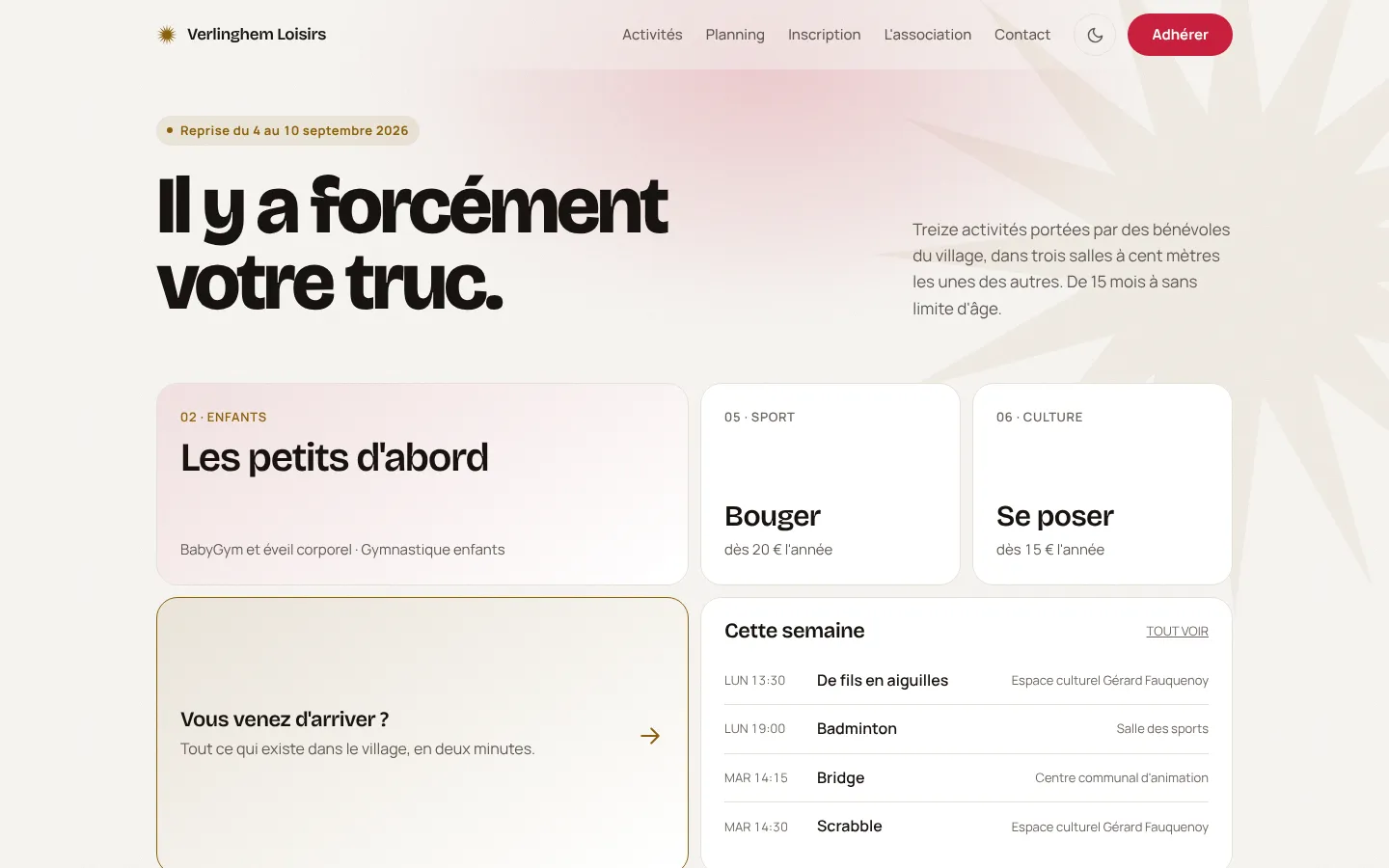
A 25-page static Astro site: a list filterable by category and day, a weekly schedule, a page per activity with its calendar file, prices, venues, a contact form, light and dark themes.
All information lives in a folder of YAML files, one per activity. Pages, schedule and filters are generated from it. The build fails if any data breaks its schema, and a script checks cross-references, schedule consistency and that no personal phone number has slipped in.
Technical choices
A Git-based CMS rather than a hosted one: content stays in the repository, versioned, and outlives the editing tool. The origin repository is a self-hosted forge, so volunteers sign in with an association login and need no GitHub account. GitHub receives a mirror and acts as build farm and backup.
CI cannot call the server, which accepts no command from outside. CI builds the image, tags it with the commit, then rewrites the matching line of the deployment file and commits it. The server watches the repository, sees the file change and redeploys. Rolling back means reverting one commit.
What was hard
On a static site, a home page answering 200 proves nothing: a truncated build would answer the same. The health probe therefore returns the commit being served and a fingerprint of the content (number of activities, venues, time slots). It proves the right build is live, and nothing more.
The base image ages even when the site does not change. A weekly rebuild applies system security patches, with a serial number in the tag so the deployment notices it.